 Tom Bakx
Interactive
Two of my papers, made playable · one tool that does a job I kept doing by hand
Three things you can open in a browser. Two are games built out of my own papers — the actual research rather than an illustration of it, using the same images, the same line frequencies and the same scoring metric. The third is a tool that does a job I kept doing by hand. None of them needs an account or an install, none tracks you beyond a page count, and all three work on a phone.
Sky Puzzle
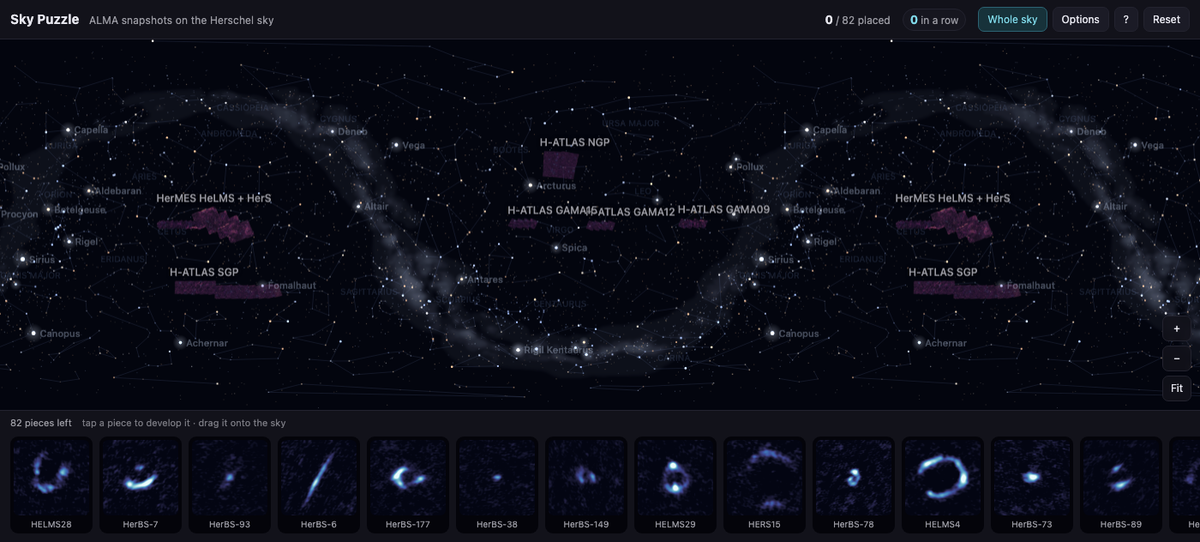
Short ALMA observations of 297 Herschel-selected sources resolve what the far-infrared surveys could only register as a single bright dot: Einstein rings, arcs and multiple images, each one a monster galaxy stretched around a foreground mass. Sky Puzzle hands them to you one at a time, magnified 1300× and badly stretched, and asks you to develop each one and put it back where the telescope found it.
The pieces are the real data: the brightness slider restretches the actual significance map rather than filtering a picture. Herschel's beam is far too coarse to tell the sources apart, so the board shows each unfound galaxy as a faint preview at its true spot — match the shape, drag the piece there, and it clicks into place. Fifty-four of them carry a note about what was actually found, with a link to the paper.
Listening for a Cosmic Chord
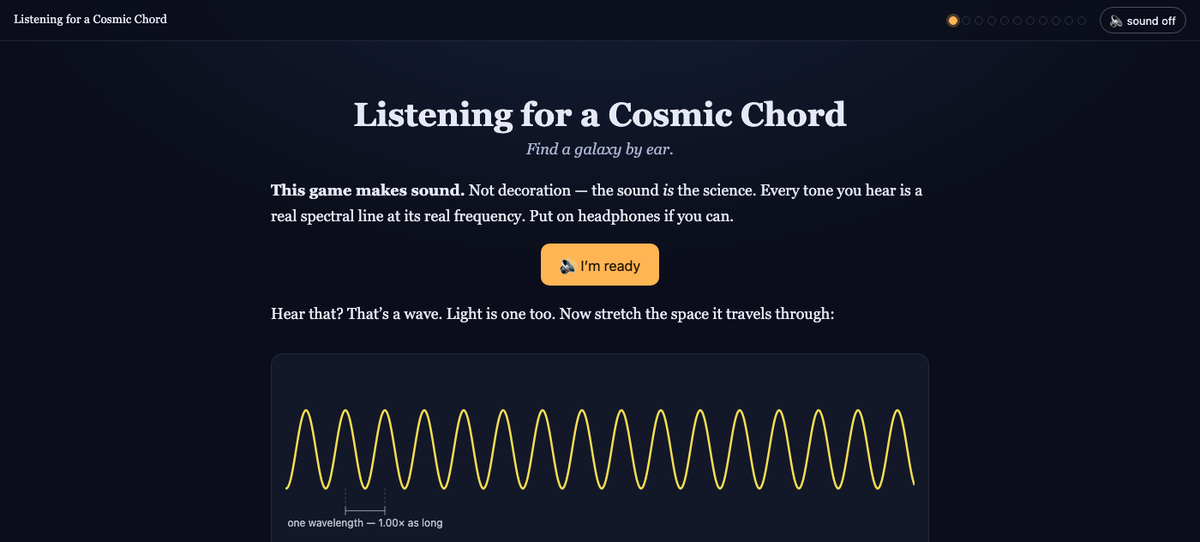
The CO lines of a galaxy form a harmonic series, which means a galaxy is literally a chord — and its redshift is the key it is played in. Listening for a Cosmic Chord lets you find that key by ear: you tune until the predicted lines stop beating against the detected ones.
Nine chapters take you from one line and thirteen possible distances, through the degeneracies that make a wrong answer sound perfect, to the lines that aren't there — and finish by having you design the ALMA tuning yourself, scored live with the metric from Bakx & Dannerbauer (2022) on the real HerBS sample. Built with INFRAVIS. The sound is the science, so play it with headphones if you can; every cue is also written out, so it works muted.
Cite the ALMA receivers
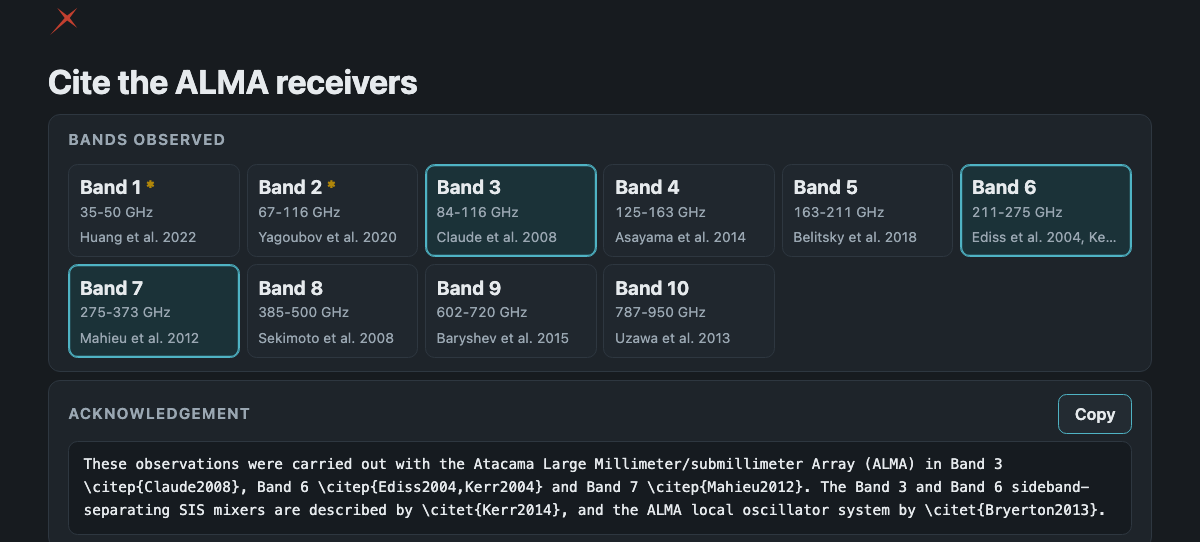
ALMA's receivers underpin nearly ten thousand papers. The papers describing those receivers are cited a few dozen times at best, which is the disparity Bakx & Conway (2024) set out to document — compiling the technical paper behind every band, in direct contact with the receiver groups. But knowing which paper to cite is one thing, and having it to hand at the moment you are writing the acknowledgements is another.
Cite the ALMA receivers closes that last gap. Tick the bands you observed in; out comes an acknowledgement sentence, in LaTeX or plain text, together with the BibTeX for every reference it names. It applies the rules the memo sets out — that the local oscillator paper belongs to every band except future Band 2, that a single paper covers the Band 3 and Band 6 sideband-separating mixers, that Bands 1 and 2 are still provisional. No BibTeX entry was written by hand: each one was verified against a publisher record or an ADS export, and the output compiles under natbib with no undefined citations.
Using the games in a classroom, a planetarium or an outreach evening is more than fine — that is what they are for, and the citation tool needs no permission either. If you use any of them, tell me about it; I would like to know what worked.